Book Review: Aurora

Aurora, Kim Stanley Robinson’s latest science fiction novel, is typically ambitious in its vision of realistic, well-thought-out space hardware, this time to the Tau Ceti system. However, despite his grandeur of scale and the realism of his hardware, Robinson seems to have made a conscious effort to undo the promise and hopefulness that many of his earlier space epics have inspired in space advocates like me. He seems to have succumbed to anger or despair in his reactions to human beings exploring and living beyond their home planet.

//ws-na.amazon-adsystem.com/widgets/q?ServiceVersion=20070822&OneJS=1&Operation=GetAdHtml&MarketPlace=US&source=ac&ref=qf_sp_asin_til&ad_type=product_link&tracking_id=rheroc-20&marketplace=amazon&region=US&placement=0316098108&asins=0316098108&linkId=QUWXDLISZADCVFSN&show_border=true&link_opens_in_new_window=true

The first book I read by Kim Stanley Robinson, The Memory of Whiteness, was incomparably ambitious, depicting a far-future solar system populated by diverse peoples and micro-civilizations held together by an advanced physics that eventually came to combine music. The characters were diverse, witty, and likeable. Since that time, many of his science fiction stories have taken place in approximately that same future, though with thematic and event changes from novel to novel.

He is perhaps best known for his epic Mars Trilogy, which depicted the exploration, development, and eventual terraforming of the planet Mars, from 2026 to several hundred years in the future. The Mars trilogy is Robinson’s vision of a liberal/environmentalist political utopia set on the red planet.

His last space epic, 2312, also portrayed a technologically ambitious future, with cities on Mars, massive spacecraft plying the distances between the planets, and even a city of Mercury (which also appeared the the two previous works). However, 2312 lacked a lot of the well-rounded characterization he aspired to in the Mars trilogy. And, like his subsequent Earth-based environmental novels like Antarctica, Robinson’s depiction of 2312 is overwhelmed by environmental catastrophes brought on by pure-evil or pure-ignorant conservatives/capitalists. He had, in essence, taken the gloves off, making much of his work more political polemic than entertainment.

The Memory of Whiteness link:

//ws-na.amazon-adsystem.com/widgets/q?ServiceVersion=20070822&OneJS=1&Operation=GetAdHtml&MarketPlace=US&source=ac&ref=qf_sp_asin_til&ad_type=product_link&tracking_id=rheroc-20&marketplace=amazon&region=US&placement=0312861435&asins=0312861435&linkId=OZTXDCDY355N65SK&show_border=true&link_opens_in_new_window=true

Mars Trilogy link:

//ws-na.amazon-adsystem.com/widgets/q?ServiceVersion=20070822&OneJS=1&Operation=GetAdHtml&MarketPlace=US&source=ac&ref=qf_sp_asin_til&ad_type=product_link&tracking_id=rheroc-20&marketplace=amazon&region=US&placement=B003U8LZBW&asins=B003U8LZBW&linkId=P6UZ6HNNEERPMNZ6&show_border=true&link_opens_in_new_window=true

2312 Link:

//ws-na.amazon-adsystem.com/widgets/q?ServiceVersion=20070822&OneJS=1&Operation=GetAdHtml&MarketPlace=US&source=ac&ref=qf_sp_asin_til&ad_type=product_link&tracking_id=rheroc-20&marketplace=amazon&region=US&placement=0316098116&asins=0316098116&linkId=7OX2BWFYQBJSYMAQ&show_border=true&link_opens_in_new_window=true

Aurora, then, combines the epic scale of interstellar exploration and all its related, believable complications with a still-damaged Earth back home in roughly the 28th century. The starship is a massive, double-ringed design with multiple simulated Earth-style environments, akin to Biosphere 2, complete with jungles and glaciers and everything else in between, and multiple cultures inhabiting each area.

Despite a crew of over 2,000 individuals on the generational starship, Robinson focuses primarily on two or three individuals within a single family, with everyone else serving as nearly faceless background characters. Warning: potential spoilers ahead. One of the most interesting characters turns out to be the computer running the starship itself, where a certain amount of depersonalization might be expected.

One of the early main characters, Devi, is more or less the ship’s chief engineer, and she spends much of her time angry. I cannot emphasize that enough because the anger in this character and several of the characters inhabiting some of Robinson’s other novels are also infused with this anger, which is directed at stupidity, shortsightedness, or general ignorance. Not that these are bad things to be angry about, but characters that stomp around a starship p.o.ed all the time get a little tiresome or unlikeable at times. Why are these people in the future so angry all the time?

Devi’s daughter Freya is less angry than her mother, though not as brilliant–in fact, she starts out the story as developmentally challenged, but eventually she functions well enough to be a leader in her own right. The only other character given a lot of attention is Freya’s father Badim, who is the phlegmatic peacemaker who tries to help his wife, daughter, and starship crewmates maintain some sort of peace. The primary story line of the book covers these three humans, their friends, and the ship’s computer as they approach Tau Ceti, explore its various worlds, and attempt to cope with technical challenges on the starship and the worlds they find at Tau Ceti. I’ll try to restrain myself on further spoilers.

Often, when Robinson’s characters aren’t voicing anger at the people who sent them on their journey to another star, they are in the grips of a despair that’s almost painful to read. Much of the despair articulates itself in the belief that human colonization of other worlds is, in fact, impossible. For example:

I bet they’re all like this one. I mean, they’re either going to be alive or dead, right? If they’ve got water and orbit in the habitable zone, they’ll be alive. Alive and poisonous.

Or there’s this, from much later in the book:

Human beings live in ideas. That they were condemning their descendants to death and extinction did not occur to them, or if it did they repressed the thought, ignored it, and forged on anyway. They did not care as much about their descendants as they did about their ideas, their enthusiasms.

Is this narcissism? Solipsism? Idiocy (from the Greek word idios, for self)?

Indeed, at the equivalent of a space advocacy conference like the ones I attend, one character physically attacks an advocate for further human interstellar travel. The wit and joy are all but gone in this book, and that saddens me as a reader and fan.

So as I’ve read his books and interviews over the years, it seems as if Robinson has been trying to disown or undo the remarkable work he did in The Memory of Whiteness or The Mars Trilogy, which did so much to inspire so many, myself included, about the possibilities of human space exploration. The flag of the Mars Society, for example, is red, green, and blue–the colors of the Mars novels. And many of the members of that Society–along with other space-advocate Robinson fans–are often libertarian and do not share his politics. Perhaps that grates him: people using the technologies he posits in support of political ideas he finds distasteful.

All that said, Robinson raises some good questions about what the future human space exploration might look like if we discover only two types of worlds out there: lifeless balls of rock that require thousands of years to make human-livable or Earthlike worlds with water that are ultimately poisonous. It’s a problem that I’ve mulled over in my own writing: if that, what then? I suspect, however, that humanity will prefer to go out there and try to learn the hard way before daring to give up on exploring among the stars. Unfortunately, Robinson does not answer the question clearly enough to make this story a fully rounded think piece. He poses a number of legitimate problems, but leaves us hanging as to what should happen next.

Conference Report: 43rd Space Congress, Part 5

Part 1

Part 2

Part 3

Part 4

Last posting on the Space Congress…

Panel: Return of Human Spaceflight to Florida

You can talk about rockets all day long, but what the space business comes down to for a lot of people is launching astronauts into space. The good news is that KSC will be launching people on a variety of vehicles in the near future. The bad news is that the “near future” in the space business is still two years away. That being said, activity is coming, and KSC is busy. For this panel, representatives from NASA’s Commercial Crew Program, Ground Systems Development and Operations (GSDO) Program, SpaceX, and Boeing were on hand to tell everyone what’s next.

Kathy Lueders, Project Manager for the Commercial Crew Program, started out by sharing the current NASA plans, which include commercial access to the International Space Station as well as the agency’s progression of “Earth-reliant,” “Proving Ground,” and “Earth-independent” exploration missions. As part of this work, Boeing is developing an international docking adapter and SpaceX will deliver it to ISS in June, where NASA astronauts will be responsible for installing it on the station.

Chris Ferguson, commander of the last Shuttle mission and now Boeing’s Director of Crew & Mission  Systems, talked about his new employer’s CST-100 crew vehicle. He joked that he’s learned a lot about social media in the last year, especially after he posted a picture of the empty Launch Complex 39A on Twitter with the comment, “One year later, the silence is deafening.” Fortunately, progress is being made, but a lot of it is behind closed doors, specifically in OPF-3, where their vehicle is being assembled and the Boeing Mission Control Center is being set up. While OPF-3 is situated next to the Vehicle Assembly Building on the NASA side of the Cape, CST-100 will actually launch aboard an Atlas rocket from LC 41 at Cape Canaveral Air Force Station.

Boeing is in the process of adding a rotating service arm to LC 41. During regular operations, the rocket will be rolled out to the pad, and then the crew will take the elevator up to the service arm to enter the capsule. The pad also will include a crew escape system similar to the wire baskets used for Shuttle, with an armored vehicle on standby to carry them away from the rocket after that.

The work in OPF-3 has included removing all of the Shuttle servicing platforms, making for a much cleaner look to the interior. In addition to vehicle assembly, OPF-3 will also support loading of hypergolic propellants, which will present some additional hazards, but none the VAB hasn’t seen before.

The vehicle itself has undergone water drop tests, but the primary landing method for CST-100 will be onto land, using parachutes and airbags. (I asked, and no, the plan is not to have the vehicle bounce around after landing, like some of the Mars rovers that used airbags after landing. The plan is to stick the landing in one place.) Boeing is negotiating with five different sites to be possible landing locations.

The spacesuits astronauts will wear on CST-100 will be made by the David Clark Company, which supported military pressure suits as well as Felix Baumgartner’s high-altitude jump for Red Bull.

Boeing sees NASA as its primary customer, but is also talking with Bigelow Aerospace about launching astronauts to one of their commercial space stations in the future. Boeing hopes to have a CST-100 launch by late 2017.

Garrett Reisman, another former astronaut, is Director of Crew Operations for SpaceX. His opening line was pretty funny: “Did you see us almost land on a boat? That was awesome!” That said, SpaceX has made remarkable progress on their launch operations, having now successfully launched 18 of 18 payloads, with 7 of those being to ISS.

SpaceX was planning a pad abort test for the following week, one of two they need to complete–the other one being an abort at the “max Q” or maximum dynamic pressure level.

At LC 39A, SpaceX will be leaving the Fixed Service Structure and Rotating Service Structure from the Shuttle era in place. The launch pad is being modified to support the Falcon 9 Heavy, which will generate 4.5 million pounds of thrust at liftoff.

Shawn Quinn, Exploration Systems Manager for GSDO, also had a great way to open his talk: “The Mars rovers are designed to find life on other planets. Our job is to put life on other planets.” Quinn provided more detail on the “proving ground” and “Earth-independent” missions NASA plans to do.

All of the hardware for those missions comes together at KSC. In 2018, NASA plans to launch Exploration Mission One (EM1-), which will use the Space Launch System to send the Orion Multipurpose Crew Vehicle on a ten-day, uncrewed mission around the Moon. SRBs will arrive from Utah, and the core stage will travel by barge from the Michoud Assembly Facility in New Orleans to Stennis Space Center in Mississippi for engine testing before arriving at the KSC Turn Basin. Orion is being built at KSC, the first time a human-rated spacecraft has been built there.

Quinn also mentioned other work that’s going on, including preparations on the flame trench at LC 39B, the NASA Industrial Area, the Multipurpose Processing Facility, the Crawler-Transporter, the Firing Room 1 in the Launch Control Center. Perhaps because he (and a lot of other NASA people) are tired of hearing that “NASA isn’t doing anything,” he made the point of adding, “It’s real, it’s happening.” Quinn stated that they were about “halfway to EM-1” and that “eventually these facilities are going to support missions to Mars.”

All in all, KSC looks to be very busy in the 2017/2018 time frame…everyone just needs to be patient.

Panel: Space Coast Logistics Challenges & Solutions – A Real Estate and Logistics Approach

Perhaps due to a quirk in scheduling, the last session of the Congress was on logistics. Logistics? Really? That stuff UPS likes to talk about on their commercials? Yep, logistics. That stuff one speaker called the “movement of goods from one location to another via various modes of transportation including the planning, pricing, tracking, and execution of timely and effective methods.” Okay, yeah, that’s one definition. Another–my own–would be “The process of getting all the stuff you need from one place to another so it’s there when you need it.”

And yes, it’s important: “Amateurs talk about tactics, but professionals study logistics.” – Gen. Robert H. Barrow, USMC (Commandant of the Marine Corps) noted in 1980.

However you define logistics, while it might not be a sexy topic in the space world, it is very much a real one. And it’s not just a matter of getting rocket parts and astronauts to Cape Canaveral to make a launch happen–space missions themselves are now part of our planet’s logistical tail (military parlance there: the “teeth” of the armed forces are the folks on the front line; the “tail” is what follows behind). In the case of SpaceX, their launches provide food, water, clothing, equipment, and other items that make their mission (human beings living and working in space) possible.

This session, however, focused primarily on the efforts required to get people, materials, and hardware into Brevard County. The first person to speak was John Walsh, Director of Cape Canaveral Port Authority, which handles the cruise terminals, bulk cargo terminals, oil terminals, warehouses, recreational areas (including beaches, campgrounds, and the Exploration Tower, which can be seen off 528). The shipping part of Port Canaveral has been working to upgrade its services to support increasing traffic from overseas, both in terms of volume and sizes of ships. They’re looking to dredge the channel to the port from 48 to 55 feet deep, to support some of the larger container ships coming to Florida. The container port is scheduled to open in May or June.

In addition to these Port improvements, the Port Authority is working to get a ten-mile railroad extension approved, which would connect Canaveral to the Florida East Coast Railway and thus the rest of the nation’s transportation infrastructure. The railway is producing a bit of controversy, however, as it passes through some wetlands and has some other issues that concern local residents. “We can get to space, but we can’t build a ten-mile railroad.” Walsh saw the blocking of the railroad as a serious problem, as most of the other Florida ports–including Miami and Tampa–are about maxed out and cannot support deeper channels.

Walsh also discussed other projects the Port Authority is taking on to improve Brevard County’s access to the rest of the national economy, including building larger warehouses (30-40 foot tall ceilings instead of 10-12 feet); building a business and logistics center at the intersection of Interstate 95 and Florida Route 524; building a logistics center in Titusville, which includes a liquid natural gas plant; acquiring two cranes to handle loading/offloading container ships; and other efforts to diversify the economy in the region. The other two statistics he pointed to were that 85% of all consumer products come in by sea, and many containers coming into Florida ports can face a 60-day delay–all good reasons, according to Walsh, to improve the state of Port Canaveral’s facilities.

Brevard County Commissioner Robin Fisher represents Northern Brevard County, which was designed as the North Brevard Economic Development Zone in 2011, essentially making it an economically depressed area. Under this arrangement, money spent on improvements to commercial properties can be reinvested. The NBEDZ also supports diversification initiatives for the area, including building (or subsidizing) cargo, commercial space, liquified natural gas production and distribution, advanced manufacturing, and logistics centers. They are also moving up the widening of I-95 from four to six lanes from Titusville to New Smyrna Beach, to support anticipated future traffic. Progress is being made, but I sense that the outrage over the rail line is holding up some of this effort.

I won’t share all of the efforts NBEDZ is making (one can find a pretty decent summary of their work on their website). I suppose it surprised me how much the area has suffered since the ending of Shuttle–they’re struggling with issues ranging from workforce depletion to urban blight, which makes (in my mind) the railroad a necessary tool for economic development. “Some people don’t like change,” as Mr. Fisher pointed out. On the other hand, Brevard County’s situation reflects one small piece of a much larger national discussion we’re having about balancing the need for economic development and environmental protection.

Robert Richter represented Flagler Global Logistics, a corporate descendent of the railroads, hotels, and land acquired by Henry Flagler in the 19th and 20th centuries. FGL has been building infrastructure projects on the land Flagler acquired, including logistics ports, warehouses, LNG plants, and the Titusville Logistics Center.

Focusing on warehouses, Richter pointed out that most logistics companies (such as Amazon.com) want to lease, not own, their warehouse space, and they want to be able to move their products as efficiently as possible. That means more “Class A” warehouse space (higher ceilings, climate controlled, easy access to roads/rails).

During the Q&A session, a couple of panel members responded to one resident’s environmental concerns, explaining that many of the building projects have environmental scientists on site to handle issues like relocating gopher tortoises or monitoring how many trees are cut down so that the organization knows how many trees to plant on protected areas later. Environmental concerns also include marine life near ports, such as manatees, dolphins, and sea turtles. Another argument the panelists put forward in support of the rail line was that one rail car equals four tractor-trailers on the road. As John Walsh put it, “I don’t want to turn us into L.A.”

Returning to the economic development theme, someone made the comparison between the Port of Savannah, GA, and Jacksonville, FL. In 2005, both ports had ~800,000 twenty-foot-equivalent units (TEU) of container space. Savannah spent money on building more warehouse space, to the point where their Port warehouse space is now ~3 million TEU, and 67,000 new jobs were created. By contrast, Jacksonville increased its capacity to only 1M TEU and has not seen the same job growth.

In addition to freight railroads and shipping, Brevard County also hopes to eventually be connected to a high-speed passenger rail line, which is supposed to connect Orlando and Miami, but which could include a spur from Orlando International Airport out to Port Canaveral. That sort of link would facilitate faster movement of people from the rest of the country into Brevard County without adding more rental cars to the roads.

Again, logistics is not exactly an exciting topic for a space conference, but it’s a necessary one. More to the point, as human activity spreads beyond Earth orbit, the “logistics tail” is only going to get longer and more complicated. The better a spaceport on Earth can facilitate traffic from Earth to space, the better and less expensive it will be to execute logistics for people living out in space. The discussions (and arguments) that one sees in Brevard County, Florida, will occur no matter where we decide to launch.

I’m looking forward to next year’s Space Congress, now that I understand how all the various parts fit together. There’s a lot going on in Brevard County and in the space business in general–it’ll be great to help it get off the ground.

Conference Report: 43rd Space Congress, Part 4

Part 1

Part 2

Part 3

Part 4

Part 5

The Space Congress details continue to unfold…I take notes so you don’t have to!

Efforts to Stimulate and Grow Space Efforts in Florida

Rather than a panel session, this segment comprised two individuals presenting papers on their topic followed by a little Q&A.

Jerad Merbitz from Kennedy Space Center presented “21st Century Launch Complex Small Class Vehicle Test & Launch Capabilities.” As part of the Ground Systems Development and Operations (GSDO) Program, the 21st Century Launch Complex project is tasked with developing ground infrastructure and equipment to test, integrate, launch, and recover rocket vehicles at KSC.

The goal, as noted in an earlier entry, is to make KSC a multi-use facility. He then went on to describe the various efforts 21CLC is doing to make the Center accessible to small-payload launch vehicles, focusing especially on the new launch pad being built within the perimeter of Launch Complex 39B. The new launch pad NASA is building for the small pad will–if it is built–support vehicles massing up to 132,500 pounds and producing up to 200,000 pounds of thrust. Launch companies, however, are free to develop and bring their own equipment, which many of the potential customers plan to do. The idea for the LC39B small pad is to have “clean pad,” SpaceX-type operations, where rockets are prepped elsewhere, rolled up to the pad, fueled, and launched.

Duane Ratliff’s paper was more theoretical: “Create Biomedical/Biotech Commercial Marketplace in LEO.” Starting from the premise that biomedical science and technology are already an integral part of NASA’s human spaceflight program, he sees the intersection of medical and space technology as a great business opportunity.

His reasoning is this: global healthcare is a multi-trillion-dollar industry thanks to an aging population and increased demand for prolonged quality of life. It’s difficult to keep up with demand for new medical products (drugs), for example, because many of them have a 10-15 year research and development cycle and costs can run north of a billion dollars.

Meanwhile, in-space diagnostics for astronauts face problems similar to those facing senior citizens, including osteoporosis, loss of muscle tone, degenerative diseases, neuro-vestibular issues, and others.

Zero gravity replicates the operating environment of the body more realistically than a “two-dimensional” petri dish. It seems logical, therefore, to conduct more commercial biomedical research (to solve problems related to aging and zero-g) at the International Space Station, which is now a national laboratory that can support commercial customers.

So why do this sort of research in Florida?

Florida has had a biomed/biotech industry since 2000. As noted previously, Florida is a state that is a business-friendly state, both domestically and internationally. It has nine medical teaching hospitals attached to its university system (including the nearby Lake Nona “Medical City” complex south of Orlando, University of Central Florida’s College of Medicine, and the Space Life Sciences Laboratory at KSC); has access to KSC; and is ranked #3 in pharmaceutical production nationwide and #2 in producing medical devices. Florida is also a very affordable state to do business, especially when compared to other “biotech states,” such as California, Massachusetts, and New York.

How would this investment regime work? Rather than focus venture capitalists’ attention on space exploration, attention should instead be directed to microgravity in low-Earth orbit (LEO) and its connection to Earth-based medical problems. In fact…talk about the medical aspect first, then worry about where the work is done. Universities would work with for-profit businesses to create intellectual property, which could accumulate to build further medical advances. Similar models have been used at the MIT/Harvard Broad Institute. Another thing that could be done to facilitate this biomedical/space partnership would be to establish a facility with common high-priced assets, such as electron microscopes and mass spectrometers, as was done at Cambridge University’s LabCentral facility, thus saving costs for startups.

Panel

Following the two papers, a panel of officials from Florida talked about the challenges involved in getting commercial spaceports started in the state: Russ Chandler and Todd Lindner from Cecil Air & Spaceport near Jacksonville and Michael Powell from the Titusville-Cocoa (“Tico”) Airport Authority.

Powell indicated that there was no single regulatory issue, but rather several, as multiple government agencies have a say in how spaceport operations might be run, including the Federal Aviation Administration (FAA) Airports division, FAA Office of Commercial Space Transportation (AST), Air Traffic Control, and the U.S. Air Force. All of these agencies, Powell stated, were not heading in the same direction at the same speed.

Lindner focused on the efforts to make a potential spaceport (and its surrounding county) marketable and affordable. Tico is looking for international customers with horizontal takeoff and landing facilities, as foreign nationals are not allowed onto the Shuttle Landing Facility (SLF). Tico is looking to obtain a spaceport license by 2016.

Chandler talked about Cecil having an identity crisis, as it is a joint civilian/military site, with over $1.5 billion in assets being handed over to the civilian side by the Navy recently. The site was licensed to be a spaceport for handling horizontal liftoff/landing space vehicles in 2010. They’re putting together a business plan, but so far, no horizontal takeoff/landing vehicles are in production or flying yet, making budget expenditures difficult to justify.

One of the biggest challenges in overcoming the regulatory hurdles is that AST and the other parts of FAA don’t get along with each other. There isn’t enough data to know what to ask for or how to operate an integrated air/space port. Air Traffic Control, for example, is concerned primarily with all traffic flying below 60,000 feet and doesn’t really care about anything above that. Also, current ATC methods are concerned with “spacing” between aircraft. Unusual traffic, such as space vehicles, would tend to be segregated out of the normal traffic pattern as much as possible, effectively curtailing regular commercial space operations. Yet another concern is that horizontal rocket takeoffs would occur and leave the airspace very rapidly while landings would most likely be unpowered, requiring a new set of priorities.

And this is all before drones are added to the picture. As it stands right now, the ATC as built (and even the NextGen system, which is behind schedule and over budget) is not equipped to handle this diverse mix of small-and-slow and large-and-fast airspace traffic.

One of the panelists compared this shift from traditional airspace management to mixed air-and-space management to the transition that occurred in the late 1950s between propeller and jet aircraft. The group seemed in agreement that the U.S., with the most dynamic market and technologies, should get out ahead of this issue and settle how to handle the aerospace ports of the future before someone else does it.

Panel: Revitalization of the Private Sector

Phil Bryden, a Craig Technologies Program Manager with an Australian accent, promised to get this panel–the last of the day on April 29–finished on time or early for beer call. He kept his word. The other members of the panel included Julie Song, owner of FL Business & Manufacturing Solutions; Troy Post, Executive Director of the North Brevard Economic Development Zone; and Gretchen Sauerman from Florida Institute of Technology.

Bryden spoke first, explaining Craig Technologies’ role in maintaining the (former) NASA logistics center on A1A in Cape Canaveral. Craig is now wrestling with the transition from one large government customer to multiple small commercial customers. Small, entrepreneurial firms want a supply chain that is fast-paced to meet their needs. Craig is looking at “disruptive” technologies such as additive manufacturing (a.k.a. 3D printing) to meet those needs. He opened up the panel by firing off the following questions:

  • How does the supply chain respond to commercial space?
  • How do you apply government lessons to a commercial environment without slowing things down?
  • How can government support the private sector?

Julie Song added a question, asking how should small businesses that were used to supporting NASA should adjust to support commercial vendors. She emphasized leveraging their existing expertise in AS9100 and ITAR–making sure to be responsive to commercial vendors without violating export control laws.

Troy Post is concentrating on providing incentives for private investment in his area (Brevard County north of the Bee Line/Beach Line expressway). The goal being to bring in new businesses without neglecting the businesses that are still there. He also recommended identifying what assets the private sector can use; finding ways to maximize jobs and capital investments; and keeping the aerospace intellectual knowledge base intact. That last item is tricky, as a lot of folks from the Shuttle era moved out or retired after the end of the program.

Gretchen Sauerman noted that Brevard County suffered a hit very like the slump that happened after Apollo following the shutdown of Shuttle. However, the area’s aerospace industry got votes of confidence in the form of Northrop, Embraer, and Harris businesses. Florida Tech has also been striving to help individuals dealing with underemployment acquire new job skills.

The discussion again turned to responding to the new, smaller business ecosystem in which Brevard finds itself. Additive manufacturing was seen as a way to reverse off-shoring of manufacturing jobs, as it allows prototypes to be made quickly and products to be built more consistently. The need for internships to attract innovative young minds was also mentioned. One local company focusing on space tech shifted over to private power boats and now makes most of its money in that industry–and that shift came as a result of a recommendation of an intern.

Another arrangement that might become common is a shared workspace where a group of small businesses might share large machine tools or 3D printers. This could be the manufacturing equivalent of coworking. The new environment will call for shorter lead times, less inventory, and “outside the box” thinking. Another challenging task for commercial space companies entering the area will be identifying space-certified local suppliers of third-tier parts, like fasteners.

One process NASA has begun is called “technology docking,” where private businesses are able to access NASA’s internal expertise to help them solve technology problems.

While these types of arrangements might help small businesses interact with the existing NASA infrastructure, private space firms such as SpaceX and Blue Origin do a lot of their work–even down to fasteners and other small-lot parts–in house because NASA-based processes and production lines have been too slow or too expensive in the past. If small businesses want to break into those markets, they will need to demonstrate high quality at lower cost as well as provide product transparency so SpaceX and others will understand how their hardware is being made. Still another challenge facing many small aerospace businesses in Brevard County is that many of NASA’s new commercial launch providers are using Space Act Agreements rather than contracts that are subject to Federal Acquisition Regulations (FAR), which usually require small-business set-asides.

The Q&A session for this discussion was quite vivid, as some locals expressed dismay with the processes businesses have to go through to get started in the region. For example, bringing in businesses to Brevard County is the overlapping responsibility of Enterprise Florida, Space Florida, Brevard County, and local cities, such as Cocoa, Titusville, and Melbourne. Given all those overlapping authorities, where does one begin? “You’re a hot mess,” was one complaint thrown at the panel, along with “The other states are kicking your butts” due to past jurisdictional squabbles.

Generally, the process should be for businesses to start at the State level first and then work their way down. Needs are identified, as well as gaps, and then finally the local and state government agencies are supposed to work together to identify the right package of assistance or incentives to settle the business down somewhere in Brevard County. Obviously the system is not perfect, but Florida is still out ahead of most states by providing a business development agency specifically geared toward helping the space business (Space Florida).

I pointed out to the group that Huntsville experienced a similar downturn after the shutdown of Shuttle/Constellation, but Marshall Space Flight Center made an effort to open up its testing facilities to commercial space providers. Meanwhile, the Huntsville government and Chamber of Commerce worked on quality-of-life items outside the gate–making conscious efforts to improve shopping, housing, and meeting space options. They also worked in conjunction with elected officials at the state and local levels to ensure that programs came to Marshall Space Flight Center. Many stretches of Cocoa and Titusville are suffering from blight. That’s a problem. In the end, a whole package has to come together for any space businesses interested in working in Brevard County, including schools, highways, community development, STEM pipeline, and other opportunities. The better the various agencies work together–and they are–the better the future for the area.

Conference Report: 43rd Space Congress, Part 3

Part 1

Part 2

Part 3

Part 4

Part 5

Apologies for the delay…

Panel: New Space in Florida – Small Companies and Innovators

I found myself calling this the 30-Something Panel in my head because the group comprised folks at least 10 years younger than me–the only panel to do so, which probably says a lot about the “New Space” industry.

First up to speak was Ruben Nunez, who works as a space consultant for a variety of organizations. He spoke of the general state of New Space, where it’s going, and what its needs are. Among its needs, paradoxically, are the young and the seasoned–engineers fresh-out of college and experienced engineers who can serve as mentors for those young folks entering the workforce.

Among the markets New Space is starting to tap are suborbital space payloads via Virgin Galactic, XCOR Aerospace, and Swiss Space Systems; space debris and satellite tracking; and high-altitude skydiving.

The next speaker was my friend (and, like me, former HAL5 member) Laura Seward Forczyk. Laura is currently running Swiss Space Systems’ (S3) business development office in Cape Canaveral. S3 is looking to launch humans on suborbital tourism flights, small payloads to low-Earth orbit (LEO), and eventually provide high-speed, point-to-point suborbital transportation here on Earth. Their primary vehicle is based on HERMES, an abandoned European Space Agency spaceplane project. It would be flown on the back of an Airbus A340, much like the Space Shuttle, and would either provide a pressurized cabin for tourists to float around or a cargo bay that would open to release a small payload at high altitude, serving effectively as a second stage.

As a way of building money for the venture, S3 is in the process of certifying their A340 carrier aircraft to be used as a zero-g “vomit comet” for zero-gravity experiences closer to Earth. In addition to zero-g tourism, the aircraft has space for suborbital, low-gravity payloads. Prices for the A340 flights range from $2,700 for the “Party Zone” to $6,700 for the “Premium Zone” of the aircraft.

John Stryjewski of Vision Engineering talked about a private venture he’s working on to observe and track satellites and space debris, first from Earth, and then from space. Space debris is becoming an increasing problem, as “space junk” can collide with useful hardware with a velocity of several kilometers per second, thereby creating even more debris.

Stryjewski’s hardware includes a gimbal for mounting a tracking telescope and the telescope itself, which has an aperture diameter of about half a meter (~1.6 feet). A privately run system would be of great interest to private industry and foreign nationals seeking information on orbital debris, as the U.S. Air Force is sensitive about releasing their best data (if you know what they can see, you can guess their targeting abilities in military situations). In addition to the tracking hardware, Vision Engineering is working on the data collection systems attached to them.

Along with the debris problem, Vision hopes to be able to visually inspect the physical state of satellites in LEO. Close-up views of these satellites could determine if they’ve been damaged or if they are in danger of colliding with another satellite.

Last up for the panel was Gabriel Rothblatt, whom I met and chatted with at Cape Canaveral’s Yuri’s Night last month. As President of the Florida Space Development Council and an enterprising individual, he is involved with multiple projects, including:

  • Florida Agriculture Conversion Task Force (FACT), which identifies suitable idle NASA facilities at Kennedy Space Center (KSC) to be used as sites for analogue farming systems for Mars.
  • Society of Pastors for Advocating Celestial Exploration (SPACE), a group designed to bring together people of faith to support space exploration.
  • FLorida Oceanic Analogue Training (FLOAT–don’t you love acronyms?), which is a project that uses the Aquarius underwater habitat as an analogue for off-world exploration.
  • The Pioneering Space Declaration, which is an online petition to get the U.S. Congress to state directly that the purpose of the nation’s space activities–particularly the human space ventures–should be for human settlement of the solar system.

The Space Declaration project was interesting to me because of Rothblatt’s reasoning for it: “There is not a business case for putting humans in space…we are losing that race [to robotics].” When you take away most of the technical activities, the only things remaining are human activities, such as making homes, starting businesses, and raising families–things that robots do not do.

The Q&A session for this panel was quite animated, covering everything from satellite insurance to S3’s payload capacity to whether Florida has what it takes to compete among the states for New Space business. The general consensus was yes, with a few suggested caveats. For example, Texas and California have more access to venture capital. Florida needs to build resources and infrastructure that allow entrepreneurial space ventures to thrive. I’ll probably have more to say on this topic in the future.

Panel: Economic Indicators, Economic Development Tools, and Recent Successes

I showed up a tad late to this panel, but when I arrived, Lynda Weatherman from the Florida Space was well into her talk about the state of business on the Space Coast. (One of the notes in my journal suggested that she try decaf, but she was firing off good information at a brisk pace.) She explained the need for economic diversity so that a community is not wiped out when one major employer goes away or loses funding, as happened in Brevard County, FL, after the end of the Apollo and Shuttle/Constellation Programs. However, Weatherman counseled against “diversity for diversity’s sake,” advocating instead for communities to play to their existing advantages and strengths.

Weatherman also described some of the specific tactics or tools local or state governments can use to support or grow economic growth, including (in Florida) Ad Valorem tax abatement or beneficial tax treatment for specific types of businesses.

Tony Burkart, Director of Business Development at Enterprise Florida, the official state agency responsible for bringing businesses to Florida, shared a lot of statistics regarding the State’s aerospace industry, specifically Brevard County, and gave a basic pitch explaining why FL was a good place for aerospace companies to do business. Since I’m a resident and fan of the State of Florida, I don’t mind passing along those stats as well:

Florida is now the 4th largest economy among the 50 states, making it also the 21st largest economy in the world. Fast Company rated us the #1 state for innovation and #2 state for aerospace. While hurt badly by the Shuttle/Constellation shutdown in 2010, Florida still has a strong aerospace industry, with 2,000 aero-related companies here and over 87,000 industry employees. Since 2010, Lockheed Martin has added 200 jobs in the state, Pratt & Whitney 230, Embraer 1,000, Northrop Grumman over 2,800 jobs, and Harris Corp. over 6,000 jobs.

Burkart explained that Florida’s advantages as a business site are similar to the U.S. as a whole: our workforce costs (compared to other nations building aerospace products), our university system, and our protections for intellectual property. Florida, because of its long history with KSC, also has a cultural appreciation for the aerospace industry along with a workforce acquainted with working in it. We also have a lot of “transplants,” not just from northern states, but internationally, making it feasible for overseas firms like Embraer to build a plant here and find people who speak their language. Florida also prides itself on a good port system, no personal income tax, a corporate income tax rate of 5.5%, and a business climate rank of #5 nationwide.

The top business opportunities for Florida (or maybe just Brevard County), according to Burkart, included commercial space, defense, and aviation. The skill sets for all three have some overlap, while the economic drivers are different, avoiding a situation where an economic slowdown in one sector affects the whole state.

I asked about the disconnect regarding finding venture capital in Florida, since most of our biggest buildings are banks. I was told that most of the VC money here goes into real estate, vs. places like Texas, where there’s been a long habit of money going into oil, “but the money’s out there.” Aerospace is tricky, however, because it’s capital-intensive and takes a long time to show a return on investment.

Other questions included local concerns about Harris potentially moving its corporate HQ to the Beltway or Northrop Grumman’s commitment to keep work here. Burkart seemed confident that both companies were here to stay.

While Florida’s weather and quality of life might seem like a slam-dunk for some, generally the cost of doing business and the ability to recruit good people locally were the prime considerations. Anyone wanting to sell a business on coming to Brevard County, however, needs to sell them on Florida first.

More to come on this topic in the next entry!

Conference Report: 43rd Space Congress, Part 2

Part 1

Part 2

Part 3

Part 4

Part 5

It’ll take a while for me to get through all of the sessions I recorded, but bear with me: there was some good stuff to be learned. The following two sessions were hosted on the afternoon of April 28.

Panel: KSC’s Transformation to a Multi-User Spaceport

Tom Engler from KSC‘s Center Planning and Development (CPD) Office kicked off this session by sharing the Ground Systems Development and Operations (GSDO) vision for the future of NASA’s Florida spaceport. GSDO’s primary mission is to upgrade the Center’s facilities and hardware to support both the agency’s upcoming vehicles–Orion and SLS–as well as future commercial customers. Engler explained that GSDO has two elements to it: Exploration Ground Systems (EGS) and the 21st Century Space Launch Complex (yet another acronym, 21CSLC). These two groups are responsible for upgrading or completely rebuilding iconic sites and equipment such as the Mobile Launch Platform, Launch Complex 39B, Vehicle Assembly Building, and the Crawler-Transporter.

As I mentioned in my previous entry, High Bay 3 in the VAB is slated to support the Space Launch System (SLS) while High Bay 2 will be refitted to support commercial customers. Much of High Bay 2 has been completely gutted, with the multi-level platforms originally built for Apollo and modified for Shuttle now refitted with adjustable inserts capable of supporting multiple launch vehicles. The Crawler-Transporter is being modified to carry up to 18 million pounds for SLS vehicles, as opposed to its previous 12 million-pound limit for Shuttle. Additionally, Launch Complex (LC) 39B will feature a “clean pad” layout, with most of the launch vehicle servicing and assembly happening in the VAB and the service tower added to the mobile launch pad, rather than being a permanent fixture out in the Florida seabreeze.

Other construction projects include a new flame trench under LC 39B, a new small-class launch site in one corner of the 39B complex, as well as updates to Control Room 4 in the Launch Control Center (LCC) to support commercial operations…and GSDO still isn’t finished. Other old equipment is being upgraded, including the data uplink station, gaseous nitrogen pipeline, and wind profiler. If there isn’t a lot of fire and smoke happening at KSC now, by 2017, there will be…a lot!

The next speaker, Darren Bedell, was from NASA’s Launch Services Program (LSP). LSP is a NASA service that helps uncrewed payloads–both NASA and NASA-sponsored satellites and planetary missions–find launch vehicles to ride. They have been busy acquiring launch vehicles for multiple missions, including SMAP, DSCOVR, MMS, and Jason-3. In addition to these missions, LSP is now looking at launch vehicles for “Venture Class” (small) Earth observation missions; however, the organization is capable of identifying launch vehicles for payloads ranging from cube sats (~4 cubic inches/10 cubic centimeters) to something the size of a school bus.

Lisa Colloredo, Associate Manager for the Commercial Crew Program, walked the audience through the various phases NASA has gone through to get from experimenting with commercial launch vehicles (CCDev1) to commercial crew services. She explained that the goal of the commercial cargo and crew efforts has been to ensure that they meet safety and performance requirements without being too prescriptive beyond that. Companies that were awarded commercial crew/cargo contracts–Boeing and SpaceX–are guaranteed a minimum of two launches per contract.

Colloredo also made a point of explaining that NASA did not mandate a specific launch site or facility for commercial crew delivery. The point being, commercial launch services are not obligated to use KSC–a point of which the Center is keenly aware.

Other updates included:

  • SpaceX will be conducting a pad abort test May 5. They are pushing for their first crewed flight in late 2016, with crewed flight certification coming in 2017.
  • LC 39A is being modified to support Falcon 9 and Falcon 9 Heavy.
  • SpaceX is building a Horizontal Processing Facility at the LC 39A site.
  • KSC is still working with Sierra Nevada Corporation and Blue Origin on their launch vehicles even though they did not win the commercial crew contracts.

Bill Dowdell from KSC’s Exploration Research & Technology Program took some time to discuss the Center’s science and technology efforts. These included the BRIC-21 mission, which studied the resistance of microbes to antibiotics in zero gravity; the Portable Onboard (three-dimensional) Printer (POP-3D) on the International Space Station; the use of carbon nanotubes on the Astrobiology Exposure and Micrometeoroid Capture Experiments (ExHam) mission; and the Next Space Technologies for Exploration Partnerships (NEXTSTEP) program.

Bottom line: KSC is multitasking as much as it can to meet current and future space launch needs.

Paper Presentations: Spinoffs from Space Technology

I’ll confess, I didn’t pay as close attention to this session as I could have. However, I did note some interesting statistics from NASA’s Spinoff (Technology Transfer) office. At present, the program has generated the following results:

  • Over 1,100 active patents
  • Over 400 NASA Tech Brief articles
  • Over 300 active patent licenses (i.e., private-sector companies licensed to use NASA-developed patents)
  • Over 18,000 jobs
  • Over $5 billion in revenue

Companies interested in learning about the types of technologies NASA has patented can visit the Technology Transfer Portal. The general process spinoff inventions follow is:

  1. Develop
  2. Patent
  3. Solicit interest from the private sector
  4. Start discussion(s) with interested company(ies)
  5. Negotiate license

The rest of the session was devoted to two success stories:

A third presentation in this session reviewed the KSC “Swamp Works” technology team’s efforts to create simulated lunar regolith (another word for dirt found on any planet besides Earth) in an effort to facilitate in situ resource utilization (ISRU) on future exploration missions. The point of ISRU is to use on-site materials on the Moon, Mars, or other celestial bodies for useful functions, such as metals to build tools or habitat shielding or water ice to make water for drinking, hydrogen and oxygen for propellant, or other crew purposes.

Conference Report: 43rd Space Congress, Part 1

Part 1

Part 2

Part 3

Part 4

Part 5

I’m spending some quality time at the 43rd Space Congress on the Space Coast learning what sorts of space activities are going on in the neighborhood of Kennedy Space Center. Short version: a lot!

Background

The Congress has apparently been a longstanding institution on the Space Coast (run since 1969), but it went off the radar after 2010, the year the Shuttle Program and Constellation were shut down. The event has been resurrected by the Canaveral Council of Technical Services and other local organizations. They’ve managed to bring in a lot of smart, informative speakers. A shame it isn’t being better attended.

In parallel with the Congress, some folks associated with the local chapter of the Project Management Institute are hosting some classes about topics like managing in an Agile software development environment. Since I arrived ridiculously early, I sat in on the Agile Development session, learning quickly that I’m not wired for that stuff, but the speaker had a solid command of his subject. He’d better: he was promoting his business, which provided test preparation for the PMI-Risk Management Professional exam.

NASA & Air Force Innovation at Cape Canaveral Spaceport

Cape Canaveral Spaceport” is a relatively new name for the Kennedy Space Center (KSC)/Cape Canaveral Air Force Station (CCAFS) complex, which is presented to potential launch customers as a single entity. This panel discussed the efforts being made by the two “sides of the house,” NASA and the Air Force, as well as Space Florida, to promote the Spaceport. The participants included Mark Bontrager, a Space Florida Vice President; Tom Eye, Director of Plans & Programs from the 45th Space Wing; and Scott Colloredo, who’s Director of KSC’s Center Planning & Development Group.

Bontrager kicked things off by assessing the economic environment the Spaceport faces now compared to the environment 35 years ago. In 1980, the U.S. controlled 100% of the world commercial space launch market. By 2010/2011, that domination had been completely lost, with zero U.S. commercial launches in those years. Things have changed in the last five years, with SpaceX, Orbital ATK, and other commercial providers springing up or actually providing launch services.

In response to this uptick in commercial launch providers, Space Florida–an entity created by the State of Florida to facilitate commercial space activity here–has been helping fund infrastructure that allows space-tech firms to get established on the Space Coast. Much of this infrastructure has come in the form of converting unneeded Space Shuttle buildings like the Orbiter Processing Facilities (OPFs) into places where the X-37B and CST-100 can be processed for flight.

Tom Eye, in discussing the Air Force side of things, was quite proud of the fact that over 800,000 square feet of office space has been leased or given to space-related businesses at CCAFS. In addition, Launch Complexes 37 and 41 are being run by United Launch Alliance, LC 40 is being used by SpaceX to launch Falcon 9 while LC 13 is being set up for SpaceX to land first stage boosters. LC 36 and 46 are being administered by Space Florida. The Shuttle Landing Facility (SLF) is being looked at by multiple customers. And while all this activity–real and potential–is happening, NASA needs to upgrade its launch infrastructure. There were 18 launches at CCAFS in 2014; there are 26 on the manifest for this year; and 2016 could see 30+ launches. That’s a lot of work ahead, but it’s exciting. Eye explained that 57% of launches at CCAFS are now commercial.

Meanwhile, on the NASA side of the house, there isn’t so much fire and smoke–yet–but a lot of construction is underway. Scott Colloredo laid out KSC’s vision to become a “multi-user spaceport,” supporting NASA’s future missions like SLS/Orion, transferring ownership of unneeded facilities to commercial users, and operating “leaner and greener.” KSC has been busy converting OPF-1 and -3 for Boeing as well as the Vehicle Assembly Building’s High Bay 2 for other potential commercial users. Launch Complex (LC) 39A is being leased to SpaceX for Falcon 9 and Falcon 9 Heavy launches.

Meanwhile, to keep its commercial customers happy, Space Florida has been helping commercial launch providers by working with NASA to streamline safety and other requirements. The point is not to provide someone like SpaceX or Boeing with a 500-page prescriptive document for how they must run their operations, but instead give them a shorter list of requirements, which say things like “Must be compliant with OSHA and FAA regulations.” Another strategy Space Florida is pursuing is long-term agreements with commercial launch providers to give them time to build a sustainable business. SpaceX, for example, has a 20-year agreement with NASA to get things rolling at LC 39A. In addition to the more well-known entities, KSC is building two new launch sites near LC 39 to support small satellite launchers. Not much of this makes fire and smoke–but it will in the next few years. SpaceX is hoping to launch Falcon 9 from LC 39A by 2017.

All of this speaks well of the Spaceport’s future prospects, but the panel still cautioned the audience not to expect a 16,000-person civil service workforce like the Space Coast had during the Shuttle era. Still, it’s a far cry from the dark days of 2010, when KSC faced the end of the Shuttle program, the cancellation of its follow-on Constellation, and a drastic downsizing of the civil service and contractor workforce. In short, the Space Coast is not “closed.”

Emerging State/Local Government Roles in Space

Jim Ball, a consultant with Spaceport Strategies, LLC, started off his talk by explaining the obvious: “This is not your father’s space industry.” Indeed, in addition to the resurgence of American commercial launch providers, other states are starting to building spaceports of their own to lure some of that business to their region. At present, New Mexico, Alaska, and Virginia have built spaceports. Texas is “in the game, but not operating yet,” and other states believe they can host spaceports of their own once reusable vehicles make it safe to do so. In short, KSC’s natural advantages–relative proximity to the Equator, open ocean, useful launch azimuth directions, and suitable port facilities–are not necessarily enough to guarantee that launch providers will automatically look to Florida as a place to do business.

Ball explained that launch service providers have a long laundry list of things they want from a state before they set up shop. On the technical side of things, they want a safe, license-able site that is operationally suitable for their needs and with access to infrastructure (highways, seaports, airports, etc.). On the business side of things, they want assurance that they will be able to launch on time, that they have launch decision authority, and that they have a reasonable amount of autonomy in how they conduct their operations. Their top three priorities, according to Ball, are unencumbered access to their facilities and equipment, commercial standards for launch operations, and operational flexibility. Like any other businesses, they want some consistency in regulations, rules, and taxes.

The State of Florida, recognizing the need to bring in more customers once it was confirmed that Shuttle was retiring, established Space Florida out of three separate state entities to smooth the way for commercial entities to do business in the state. To that end, this quasi-state organization (“a county without geography” was one colorful description I heard today) has a charter to promote and grow Florida’s space industry and capabilities; identify, plan, and fund space infrastructure; own, manage, and operate Spaceport Florida; and of course ensure public safety. Other states will establish similar entities eventually, but for now Florida is unique in creating this organization.

Keevin Williams, a VP of Special Projects at Space Florida, focused on the financing and regulatory efforts Space Florida has promulgated in support of the space industry. To that end, the Florida legislature has put spaceflight informed consent laws into effect; as well as a research and development tax credit for space-tech companies. In 2008, the Florida Growth Fund was empowered to invest up to 1.5% of the Florida pension fund in high-tech companies, including space entities. Meanwhile, the Florida Opportunity Fund makes $500K-$2M investments in small companies. In addition to these financial votes of confidence, Space Florida has facilitated the hand-over of Shuttle Program facilities to commercial industry, leaving them to pay only operations and maintenance fees so they can concentrate on developing their technologies. Williams describes much of what Space Florida does for the space industry as “blocking and tackling” regulatory and financial problems.

Leigh Holt, who has advocated for the space industry at the county level, explained that all these policies have become institutionalized into the Florida law books and budget by convincing the legislature that space infrastructure is, in fact, a transportation service, akin railroads or highways. Money for space is always scarce, but the highway budget in Florida is well funded, which might explain why we have construction year-around. A $1.5M line item for “space” gradually morphed into a $22M transportation infrastructure item. These sorts of changes occurred at the local level because Space Florida and NASA couldn’t and wouldn’t “lobby” for them.

And while this forward-thinking legislation and funding puts Florida out ahead of the other 49 states, a lot of the space-friendly lawmaking was born out of the panic that ensued once the locals in Brevard County realized that Shuttle was going away. The area had suffered massive layoffs and a long recovery period after the end of the Apollo program, and the locals were determined to prevent a repeat of that downsizing as much as possible. They haven’t been completely successful, but the current state of business on the Space Coast owes a lot to the efforts Space Florida has made and to the successes of SpaceX.

These two panel sessions provided great background for understanding the state of the space business here in Central Florida. I will share other insights in the near future. But for now, I must crash. Back at it again tomorrow. Part 2 can be found here.

Why Space?

Occasionally someone will ask, so below are the reasons I’ve supported space exploration–particularly human space exploration–as an eminent good worth pursuing.

Economic & Intellectual Growth

I think space exploration–the robotic and human variations–leads to economic growth because people must be employed and equipment must be designed and built to make the journey happen. Because of the unique environment of space itself as well as the planets in our solar system, that hardware must meet unusually high standards of performance that are never required on Earth. However, once the technologies are developed for exploration elsewhere, those high standards can and do result in better tools here on Earth.

I also responded to philosophy professor Gonzalo Munevar’s concept of serendipity, wherein discoveries made in space only afterward become useful intellectual “spinoffs” when someone realized that a knowledge gained in one place could be useful for a more practical problem here on Earth. Moreover, the continued scientific exploration of the space frontier changes science itself and causes those who practice it to change the nature of the questions they ask and answer. Those types of changes have happened throughout human history.

The Potential for Improving Our World

One anti-space argument I hear often is, “We shouldn’t explore space because a) we haven’t made Earth perfect yet or b) we have screwed up Earth so badly.” Argument a) is ridiculous, as the “perfection” of Earth is either physically or socially impossible, especially if the definition of “perfection” keeps changing. Argument b) assumes that the listener will accept the “guilt” of humanity in permanently screwing up our home planet. I don’t guilt that easily, as there are innumerable amazing and positive changes and works of art and science that would never have happened without the presence of humans. Yes, we’ve done (and continue to do) bad things, from clear-cutting forests to pollution. But we also have the ability to take action to fix those problems, and space exploration has given us the realization that we need to do something (think of the Apollo 8 Earthrise photo) and in some cases space exploration provides us with the tools to fix the problems.

600px-Apollo_10_earthriseOne can look at space-based solar power as one potential energy source that could improve the level of pollution put out by hydrocarbon fuels.

During the last Iraq war, a water filtration system originally designed for the International Space Station was installed in a village in Iraq to provide clean water for the people living there.

NASA technologies used for exploration have been turned around and used to treat cancer.

Now I know some people get tired of hearing the “spinoff” argument–and I’m not certain about the actual rate of inventions anymore. However, it is my contention that just spending money directly on an Earth-based problem will only result in a refinement of an existing technology rather than applying a wholly new technology to a problem like cancer. Or any other problem.

Inspiration & Other Human Reasons

Space exploration is, for me, one of the most challenging, inspiring actions humans can perform. It speaks to our willingness to explore, to investigate, to learn, to reach beyond our current abilities, to develop ingenious devices capable of solving complex problems. Some day, it will lead to human beings building homes, families, and whole new ways of life beyond the world of our birth.

And yes, we will no doubt take our conflicts with us out there–our fears and doubts and religions and competitions and paranoias and poor judgment. We will go for science and we will go for wealth. We will go to find new and better ways of life and no doubt some will go for power. But all the same, we will be who we are, and we will make supreme efforts to survive in unreal and dangerous environments because that is part of what we do. The effort will not radically change who or what we are in the near term, but in the long term we might learn how to ask new and better questions of ourselves, and that’s an adventure worth attempting.

Playing Astronaut vs. Simulating Exploration

Last night, I attended, as part of Yuri’s Night festivities, a public panel discussion related to the 5th International Workshop on Lunar Surface Applications. Sounds like a mouthful. What was it for?

Think about the last time human beings explored another world. Okay, you might be too young for that. It was during the Apollo program, 1969-1972. Before we sent astronauts to the surface of the Moon–the first time that had ever happened in human history–we had to give the men in the lunar lander some idea of what to expect an how to react. Exploration is risky because people die from unexpected hazards: uncertain ground, strange creatures, bad weather. So the astronauts were prepared in a variety of ways, from spending days and weeks at a time in a cramped flight simulator to hanging them sideways with bungee cords to help them feel simulated lunar gravity to trekking through the wilderness for survival training.

We have similar training hardware for astronauts going to the International Space Station, but exploration of other worlds is an art we’re slowly relearning. And the Moon is only one possible destination. There are plans to send people to asteroids and Mars, which are different landscapes from the Moon with different gravities and with much longer transit times…months instead of days or weeks. Scattered across the globe, you can find simulated space exploration habitats, where human beings are learning how to live on other worlds. It’s about a whole lot more than just “playing astronaut.”

The participants, hosted by the inestimable Ryan Kobrick, included:

Each of the individuals on the panel discussed their experiences at these habitats, each with its own level of realism to simulate (or create analogues of) specific aspects of space exploration.

Jason Schuler/Desert RATS & Swamp Works

Since 2009, NASA has been operating 7-10-day simulations for lunar exploration hardware. Jason Schuler, a robotics engineer at Kennedy Space Center, has participated in KSC’s “Swamp Works” team, which contributes to the effort. They send a group of engineers and astronauts (or NASA people who would like to be astronauts) to work with prototype or simulated crew habitats, vehicles, and field equipment.

SEV
Simulated Space Exploration Vehicle (Source: NASA)

The simulation area is often terrain that resembles the Moon or Mars, such as lava flows, craters, or deserts. The “crew” have to live in close-quarters habitats and wear “spacesuits” when they go outside, just as they would on the Moon. They try to perform specific tasks, such as conduct science experiments or build a spacecraft landing pad. They also experience simulated “emergencies.” During one such drill, a two-vehicle mission crew had to cram into one vehicle and spend the night inside one vehicle.

Annie Caraccio/HI-SEAS

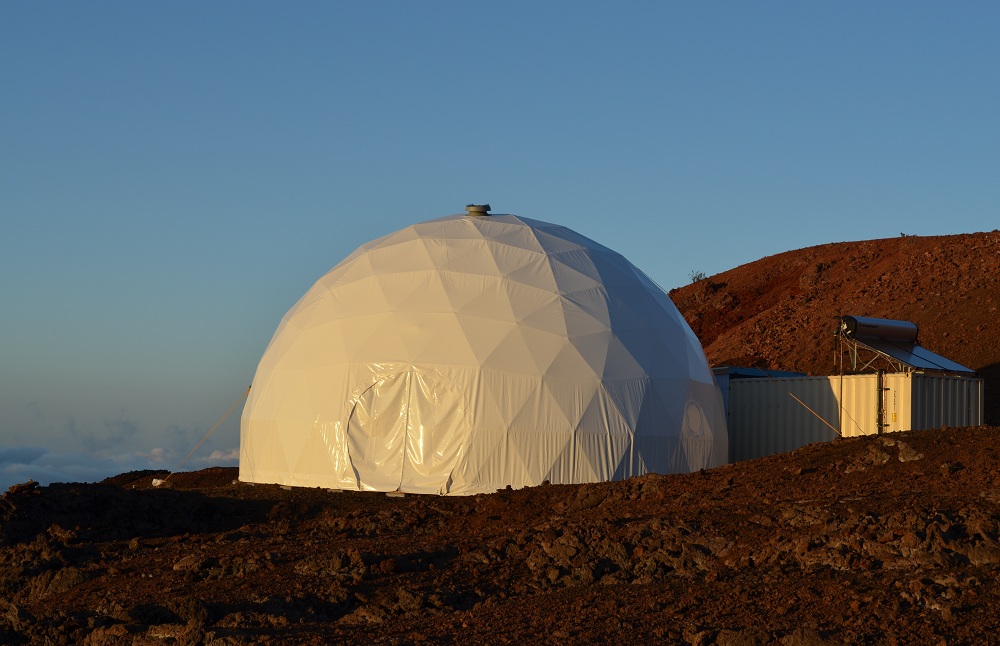
Way up in the thin, dry, non-tourist-friendly parts of Mauna Loa on Hawai’i’s Big Island, you can find the Hawai’i Space Exploration Analog and Simulation (HI-SEAS). Here, in the shadow of the world’s tallest mountain (base to summit, taller than Mt. Everest), Mauna Kea, NASA has built a simulated Mars base. Here, participants go through a competitive process akin to astronaut down-selecting before they ever get to join: personality tests, physicals, survival training, psychological testing, etc. Once there, they are signed up for 120 days or more. Like Desert-RATS, the crew must put on a simulated spacesuit to step outside. They experience a 40-minute communication delay, which is similar to the light-speed delay that would happen at Mars.

HI-SEAS Habitat
HI-SEAS Habitat (Source: HI-SEAS)

Quarters are cramped, but the science and engineering goals are real. Annie Caraccio, a KSC chemical engineer, spent her four-month stint on top of Mauna Loa working out ways to reduce or reuse waste on space missions. On the International Space Station, you can wad up trash into football-size packets in plastic bags and drop it into the atmosphere, where it burns up upon reentry. That option is not available on the Moon or Mars. So what do you do with it? Annie was looking into using some of the waste as fuel for a reactor of some kind (think Mr. Fusion on the back of the DeLorean at the end of Back to the Future).

The trick? The garbage reactor only works with specific types of waste. So Annie got the notion of asking her fellow “astronauts” to separate their trash into organic, plastics, an metal–much like we do here on Earth. As you might suspect, compliance was not 100%, leaving Annie to do some more thinking about what NASA calls “human factors.”

She and her team also poked around the Mauna Loa summit for lava tubes, which could–on the Moon or Mars–be used to house habitats sheltered from radiation.

Despite all this focus on technology, HI-SEAS actually started as a psychological study, focusing on things like cognition, group cohesion, biopsychosocial behavior (whatever the heck that is), and individual adaptation in an isolated, time-delayed environment. These are aspects of long-term space exploration that we need to study now.

Tom Potts/Aquarius

One environment that closely resembles many aspects of space exploration is underwater. Submerged five miles off the southeast coast of Florida, the Aquarius Reef Base serves as a long-term underwater lab for simulating exploration. Crew members use saturation diving, in which divers’ tissues are saturated with nitrogen. This allows crew members to work underwater longer. The risk of the bends is less, but it takes 17 hours for them to decompress before they return to the surface.

Swimming underwater is akin to weightlessness–NASA uses it to train its astronauts. Being in a pressurized steel can for days or weeks at a time is akin to being in a submarine or a spacecraft.

AquariusAgain, the crews are doing actual science. Unlike HI-SEAS or the Flashline Mars Arctic Research Station (to be discussed shortly), communications are real-time, and the crew have wireless internet. Once a NASA program, Aquarius is now managed by Florida International University.

Ryan Kobrick, Mars Society Research Stations

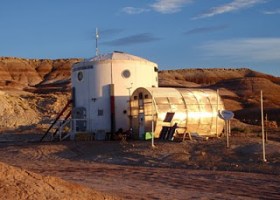
Since 2001, the Mars Society has been operating a Mars mission simulator in the most Mars-like environment they could find on Earth: Haughton Crater on Devon Island, in the Nunavut Province of Canada. How realistic is it? 75 degrees North latitude, an arctic desert, with a massive meteor crater, an temperatures that can drop to -40 degrees (“Fahrenheit or Celsius,” Ryan quipped. “It doesn’t really matter at that point”). Communications–especially internet–are delayed 20 minutes. Given that the teams operate in polar summer, the sun is up 24/7, allowing them to simulate a polar mission on Mars.

The habitat is a two-story “tin can” akin to a spacecraft Mars Society President Robert Zubrin postulated in his 1996 book //ws-na.amazon-adsystem.com/widgets/q?ServiceVersion=20070822&OneJS=1&Operation=GetAdHtml&MarketPlace=US&source=ac&ref=qf_sp_asin_til&ad_type=product_link&tracking_id=rheroc-20&marketplace=amazon&region=US&placement=145160811X&asins=145160811X&linkId=PENKBLATKBUPWLBS&show_border=true&link_opens_in_new_window=true“>The Case for Mars. The mission participants–who will go anywhere from two weeks to four months–wear simulated spacesuits, of course, though they also have an observer with them who is wearing simple arctic winter gear…an a rifle, in case there’s a polar bear nearby. But here, again, the teams are doing engineering work or performing field science, such as drilling for cores of the permafrost.

Ryan’s team even simulated a Martian “day” for a month, adding 39 minutes to their day. After a week of feeling jet lagged, they learned to like it, as it gave them more time to work.

The Mars Society also runs a Desert Research Station in the high desert of Utah, where crews going to Devon Island spend a couple of weeks training before they head for the frozen north. And yes, they follow the same rules as they do on Devon Island, but if there’s a problem, help is closer to reach. The closest airport is an hour away from the arctic station, assuming the airport is operating and has a plane available.

Cady Coleman, Antarctica/ISS

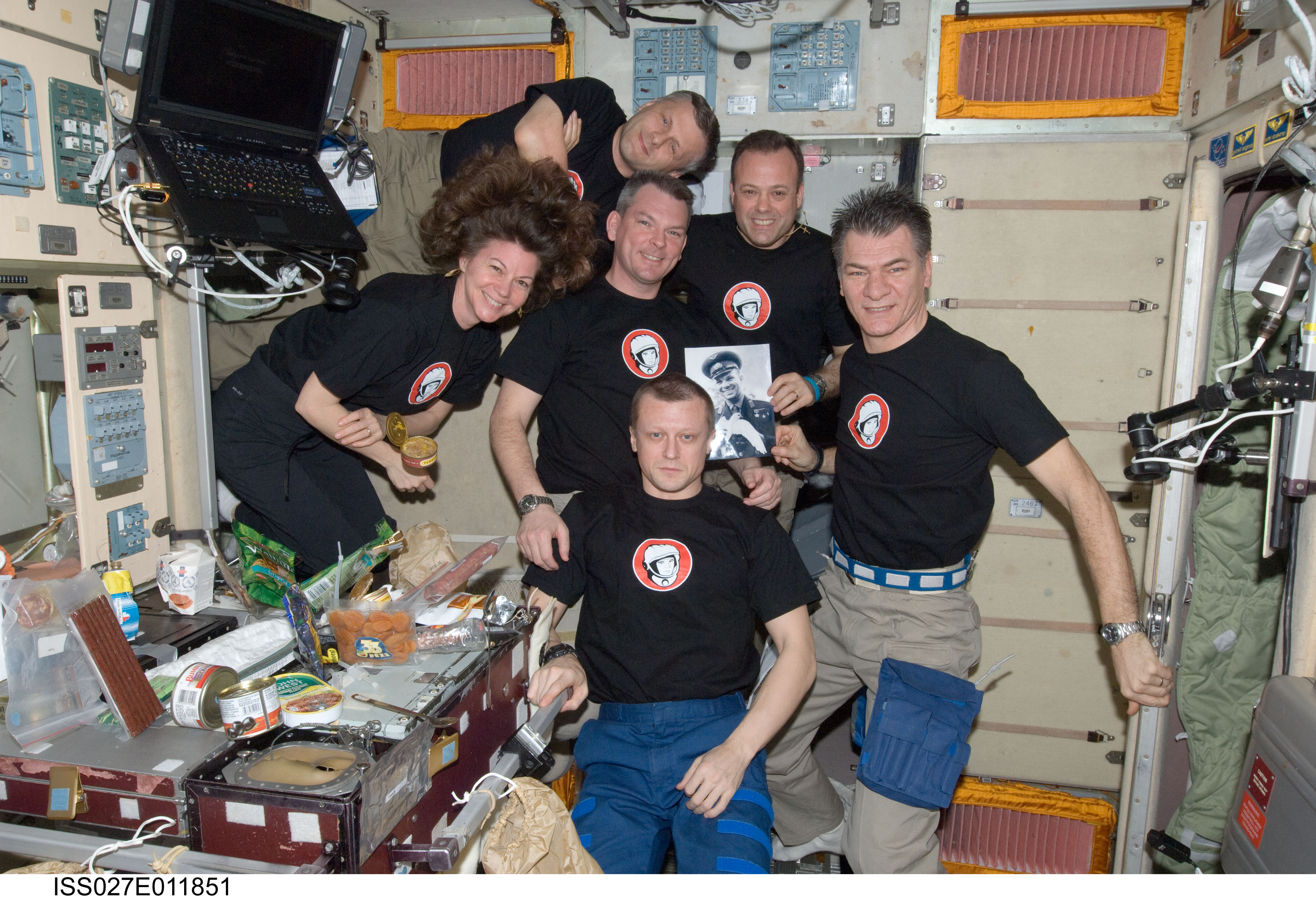
The obvious star of the evening was Cady Coleman, a NASA astronaut who has done Space Shuttle missions and a tour on the International Space Station. She was fascinated by the Earth-based simulations and interested in doing a couple of them herself (she’s been on the NEEMO mission on Aquarius). But obviously she was one up on everybody, as she’d actually spent three months on ISS in space, which is the point of all these Earth-based exercises.

Coleman also has spent time in Antarctica, on the other side of the world from Devon Island, collecting meteorites. Her insights were worthwhile, with most of the audience members curious about crew dynamics–how people got along–on the Station. In the end, I suppose, that curiosity is inevitable: human spaceflight is all about humans going out and doing things out on the frontier. If we were only going to send robots, the question of how people get along wouldn’t come up because robots just obey orders. We humans can be a cranky lot, especially when we’re in a strange, unfamiliar, or uncomfortable environment away from many of the support systems we take for granted here on Earth.

iss027e011851
Source: NASA

While NASA doesn’t exactly hide the potential downsides or conflicts that can occur among ISS crews, they’re inevitable. Coleman, diplomatically, explained some of the social work-arounds that her crew developed. For example, one of her Russian crewmates “clearly had never worked with women before” and would not answer any of her questions unless she got very insistent. The work-around became: the other Russian astronaut would often have the same question Coleman did, so he would ask his compatriot the same question, and they would get the answer that way.

Coleman also mentioned some friction she experienced while hunting for meteorites in Antarctica. She was getting cranky about things one of her crewmates was doing, but then stopped herself, realizing where she was. In Antarctica, as in space, she said that “the mission is so compelling,” it overrides most of the minor social issues.

Closing Thoughts

The evening closed with a good question: “What do we still need to work on before we get a base on the Moon?” The primary answer was: logistics. That encompasses everything from identifying how much stuff really needs to be sent up with a crew to ensuring that what they send is the correct stuff for them to perform their mission. A lot of hope was being placed on In Situ Resource Utilization (ISRU), a fancy NASA term for using resources on the Moon, Mars, or elsewhere so that the crew doesn’t have to bring everything with them. There was some grumbling about money, which is always tight. There’s a lot of debate about whether NASA is being funded appropriately to even attempt deep-space exploration. Ryan Kobrick got the last word in, suggesting that we just need to take more risks: “Less complaining, more doing!”

Are You the Person You Were in High School?

In a couple years, it will be 30 years since a graduated from high school (go ahead, do the math, I’ll wait). It’s an experience that has come and gone. I was not athletic back in the day, nor was I a particularly good student. I was bright, but lazy, and desperate to get out of the place where I was–a 2,000-student public secondary school in the Chicago suburbs. It was not a particularly dangerous place, but it was not 100% nerd/wimp/geek-friendly, and that was who I was 20+ years ago.

I don’t dwell on high school that much anymore. It certainly wasn’t the best of times, but it wasn’t the worst of times (that was junior high). I was eager to get out, and in fact did graduate a semester early to be clear of the place. But I cannot deny that my adolescence shaped me, as it does everyone.

Why do I even bring up high school as a blog topic now? I had an extended text chat with one of my female friends from back-in-the-day this evening, and it got me to thinking. The friend in question was not a “girlfriend,” but someone who thought well enough of me to invite me to her church as a way of helping me find somewhere that I might belong. The church didn’t work out, but I don’t blame the friend for the mismatch. I just marched to the beat of a very different drummer, and it would take a few more decades, in and out of church, to figure out who I was as a human being.

However, as far as my high school experience goes, the conversation with my friend was surprisingly eye-opening. I learned that a mutual friend had wanted to “come out,” but had not until after high school, and that he had passed away years ago. I had to silently mourn for someone who had, at least on my terms, been a good and decent person. I learned about some of the problems in my friend’s personal situation, of which I knew nothing at the time, but her story helped me better understand (now) why she might have sought the need to belong to a group of moral Christians.

And perhaps I learned how little I knew about some of my peers. Yet many of us struggled during that age range when hormones are dominant and maturity…not so much. And one must combine those hormones with whatever situation the adults in our lives added to them; then you realize how screwed up we all were…or are. Well-meaning parents and school administrators might do their best in the 21st century to eliminate “bullying” and other behaviors, but one way or another, human beings are simultaneously social and solitary animals, and we learn most of our hardest lessons by making social errors with our peers. And those lessons carry forward into our adulthood.

If I learned anything important in my teens, it’s that social problems of that age range are temporary and should be taken with a large lick of sodium chloride. I learned how to find happiness and satisfaction in solitary interests and pursuits, such as reading and writing. I learned to keep a positive attitude about the future, especially if the present sucked, which in high school it often did. And maybe I learned to like myself a little better because if I didn’t do that, it seemed certain that no one else would.

But I won’t kid you: some of the emotional scars from back-in-the-day remain. It was really difficult to thank the guy who, at the time, was the toughest of the tough guys and yet also the guy who told the bullies to leave me alone. I was glad I thanked him, but yet how many of us really like to admit that we “survived” some period of our growing-up period thanks to the munificence of another person?

I was bad at dating in my teens, and I’m still bad at it, perhaps because of all the confidence I allowed to be taken from me at that age.

And lastly, I suppose the important part about the emotional scar tissue we acquire when we’re young and impressionable is that it stays with us much longer than we might expect.

Our social expectations–for good or ill–are set in our teens. Sometimes they are set accidentally, as we have some experiences that make us say, “I will never do that again!” Or sometimes we have experiences (good or bad) that lead us to believe that life will always be this way, and that is the pattern that is imprinted on our lives from that time forward.

It’s bizarre, hilarious, nasty, hormonal, ugly, and terrifically human all at once. I won’t pretend that it was all wholly bad, nor that it was some sort of adolescent utopia. Somehow or other, I learned to interact with other people, and nothing teaches that faster than the daily series of potential foul-ups that constitute high school. While those who really enjoyed high school might frown on this characterization, I think it’s safe to say that we all endure our teenage years, and eventually we use those times to help us become useful adults…or not.

Yuri’s Night 2015

LogoYurisNight_WHITEring_TRANSPARENTbackground250x250As a practicing introvert, I don’t make a big habit of getting out into public for large parties. Once a year, I make an exception for Yuri’s Night. For the uninitiated, Yuri’s Night is an excuse for space geeks and other space-interested folks to get together and celebrate the anniversary of the first human to fly into space, Yuri Gagarin. The brainchild of Loretta Hidalgo (now Hidalgo Whitesides), whose birthday is April 12, the original concept was sold as a “Cinco de Mayo or St. Patrick’s Day for space geeks.” The concept went viral quickly, with the “official” site (Loretta’s, of course) providing logos, selling t-shirts, sharing party sites, and offering tips for setting up one’s own festival.

What exactly happens at a Yuri’s Night party? Truth be told, it varies. Some folks show up in space- or science fiction-related costumes. Some folks plaster Yuri Gagarin temporary tattoos on their bodies, like my buddy Laura Seward Forczyk.

LauraWhat else happens? Well, space people show up just to hang around other space people. And by space people, I guess I mean those of us who are fascinated by space exploration or even actually work in the space industry–NASA, military, or private sector. Depending on the dedication, organization, and resources of the people involved, It can be a party in a bar, which is what we did for the first Yuri’s Night in Huntsville (thanks to Laura for reminding me! And yes, that’s me in the Hoban Washburne shirt below)…

Laura Bart and Emily…to a takeover of a wine shop with a space art installation and band, as they had at Bacchae Wine Bar in Cape Canaveral, Florida last night…

image3 image4 image5 image6 image8…to a full-blown invasion of the Space & Rocket Center in Huntsville…Under the Saturn VThe point being, hey, it’s an excuse to party, have fun, be a tad silly, and hang out with people who share a common interest in, and love for, space exploration. Is there drinking? Certainly. Par for the course, I suppose. But the point isn’t just drinking, like other holiday gatherings I could name. And sometimes you can even do a little good. I recall that at least one of the Huntsville events raised money for Court Appointed Juvenile Advocates (CAJA). These are “my people,” so of course I join in, even if it gets a little loud at times.

***

I always learn something or talk to interesting people at Yuri’s Night. This year, one of my interesting talks included Chris Lewicki, CEO of Planetary Resources, who was in Florida because his company’s Arkyd 3R satellite was about to be launched to the International Space Station. From ISS, it will be launched into a low-Earth orbit from the Kibo science module. Once in its proper orbit, it will test technologies that will eventually lead to an asteroid-detecting and -prospecting spacecraft.

Chris Lewicki Ryan Kobrick Me
From left to right, Chris Lewicki (Planetary Resources), Ryan Kobrick (Space Florida), and Your Humble Narrator, babbling on in my Science Cheerleader t-shirt

***

Another worthwhile chat I had was with Gabriel Rothblatt, a lawyer and space advocate who recently ran for Congress in Florida’s 8th District (the Space Coast, of course!). His big interest when we talked was in streamlining the process for commercial space companies that want to launch their rockets out of Cape Canaveral Air Force Station (CCAFS). He’s advocating for a “Port Authority” sort of structure, where the actual Port of Cape Canaveral would also have launch approval authority–from cruise ships to space ships!–and any potential launch customers would only have to go through one set of red tape to get approvals.

For instance, if SpaceX wants to launch off of Launch Complex 39A, they have to get approvals from NASA for use of the facilities but also from the U.S. Air Force, which maintains the Eastern Range off the Florida coast. A Port Authority for the Space Coast would maintain its existing facilities plus a few of the launch pads at CCAFS, which would be converted to commercial use. It would be the Port Authority’s job to centralize approvals so that a launch customer would only have to go through one round of red tape instead of two or more.

Rothblatt was also interested in some of the “singularity” technologies, including nanotechnology. Nanotech, theoretically, could extend life spans by providing people with molecule-sized robots in their bloodstreams that would kill things like cancer, clear out cholesterol, etc. Why get interested in longevity? Aside from extending life spans, it could change the dynamics of space investments. Rothblatt reasons that if people were living 150-200 years instead of 70-100, they might be more willing to invest in ventures such as space settlements, which will take decades beyond the usual planning (or investing…or even thinking) horizons of most people alive today.

A third cause Rothblatt advocates for is space settlement. “Fifty years ago, we had to send humans,” he said. “The computers weren’t that good or that fast. Now they’re getting to the point where they can most of the basic things without the need for humans. Space settlement is the only compelling reason to send humans into space” long-term. It’s hard to argue. Settlements mean families, communities, businesses, cultures, and all the things that (so far) only humans do. A lot of what he was saying sounded familiar, so I asked if he’d been talking with Rick Tumlinson. Indeed he had, which was why he was talking to Tumlinson’s New Worlds Institute about space settlement.

There are exciting things happening in the space business. It’s not quite that NASA-centric vision that America had in the 1960s, but a lot of our rapidly developing technologies are making space more democratized and, eventually, more accessible. And perhaps, more hopefully, dedicated individuals are willing to run for Congress to promote a technologically promising future. It’s that sort of thinking that makes even an introverted space geek like me happy he goes to a loud party once a year.