You’re an Introvert? But I thought…

I have spent enough time on my own with my thoughts to understand that I’m an introvert. I’m single, and happily so. I depart social gatherings of >5 people within about two hours. I spend extended periods of time taking walks on my own or hanging out at home with no great desire to require the presence of other people.

And yet…

At last count, I had over 1,100 LinkedIn contacts and something like 860 Facebook friends. My primary place for walking around “alone” is Epcot at the Walt Disney World. Certainly those can’t be the behaviors of an introvert!?

Actually, they can. The internet is a curious place, and a great environment for an introvert who normally wouldn’t talk to others much to open up and share his or her creativity. Here’s the thing extroverts miss: you don’t have to talk to make friends on the internet.

Okay, and yes, I do actually talk to people in public. This has apparently become a misconception among those who speak more often. I’ve run conferences. I’ve managed events for crowds of talkative cheerleaders. It can be done, but there is a price to be paid. That price comes in the form of physical tiredness from trying to give every person you meet the benefit of your full attention. That’s simply the way introverts are wired. We can’t do “small talk” or “chitchat” without wanting to know the how and why behind why someone said something. Call it Compulsive Analysis Disorder if you like.

If you’re someone who spends a lot of time alone, you get used to certain things, like time, peace, and quiet to collect and organize your thoughts. I made the mistake of attending a college football game in person yesterday, and I was a bit overwhelmed and drained by all the noise around me. I’ve been watching football games at home, at the homes of friends, or in saloons for over 25 years. The number of people and level of noise present in an actual stadium is considerably more than what I normally experience in my preferred locations. In similar wise, I haven’t attended a live concert in 15 years and am no longer a regular movie goer. Both activities involve large crowds, over-stimulation (too much/too loud noise), and a need to speak more loudly than I might prefer.

All that said, I spent most of the first half of my life rather talkative–even too loud or outspoken, now that I think about it. That made me (initially) a good fit for Disney, where talkative and sociable are an accepted and expected part of the schtick. However, it was in my twenties that I came to realize that I was happier in quieter areas, away from large groups of people. When the opportunity came up to apply for the Disney Cruise Line, I considered it, then recoiled in horror: imagine interacting with the public all day but then at the end of the day being unable to drive some distance away from the crowds and enjoy the peace of your own space! Cabins are shared on the cruise ships, and there really isn’t anywhere you can go to “escape.”

It wasn’t until I started working as a writer for a living (a relatively quiet job) that I began to relax with the Mouse. And as I was moving on to technical writing, I realized it was just in the nick of time: the “Guest Letters” department was about to be transitioned from a literary to primarily a verbal activity, with guest concerns handled over the phone. The thought of talking to strangers all day–apologizing for problems, no less–was a bit too much to take. One of the office extroverts was excited–she couldn’t think of anything better than to do that all day! So even before “introversion” became more of a social [sic] phenomenon, I was learning a lot about how I operated among people. And while I can work with groups–even large crowds–that doesn’t mean I prefer to do it every single day. If I do have to work with large groups multiple days in a row, I come out of it tired, grouchy, and in deep need of time alone.

Again, I have friends who are surprised when I tell them I’m an introvert because I’m “so friendly” at work. Introverted does not equal unfriendly. It’s perfectly possible to be friendly and talkative as an introvert. However, at the end of the day, that introvert often will go home or some other quiet place to savor silence–others’ and their own. It’s not a reflection of others (most of the time), it’s simply the way we’re wired. And it’s a mistake to underestimate an introvert’s ability to interact with others. We understand people rather well; but we can be selective about how much we put that understanding to work. Just some food for thought from an introvert with more connections than one might find “normal.”


It’s a Serious World Out There

From a very young age, I can remember being told that I “take things too seriously” or “take yourself too seriously.” I’ve always found this a curious criticism, because it continues to the present day and I still can find nothing wrong with the behavior.

Is life meant to be enjoyed? Most likely. We humans are wired for it. I manage to do so when I can, in my own ways: reading, writing, traveling, enjoying the companionship of friends and family, enjoying meals and fine beverages, occasionally seeking out the company of a closer partner. These things make me happy. I recognize that my tastes run to the cerebral and the serious: my primary forms of entertainment are science fiction, philosophy, and history. I recognize I can get grouchy on occasion and so try to keep a balanced attitude toward my life, considering myself neither as evil nor as brilliant as some of my delusions would have me. I can even laugh at myself on occasion.

But yes, I take some matters quite seriously, or personally.

I believe life is a serious business, something we are granted for mysterious reasons still unknown to us. Given how rare and precious the gift of life is, I try to make my life worthwhile or productive. I dislike a lot of frivolity and what I would call serious wastes of time (television sitcoms and cinematic romantic comedies come first to mind). For reasons clear only to myself I take rudeness and malice quite personally, especially when they’re unwarranted. I suppose if I have a redeeming trait in the midst of all my hard thinking, it’s that I prefer to treat people with kindness until they give me a reason not to do so. It was not always so, but I’ve made that effort in my 30s and 40s.

If someone disregards, insults, or hurts me, yes, I take that personally, and yes, I take it seriously. Good grief, why shouldn’t I? Is meanness something to be laughed off? Is evil something to be tolerated? That said, it usually takes a lot of pushing and petty cruelty before I push back. And yet when I do push back, I’m then told that I take things too seriously.

Somewhere early in my childhood, I suppose, I developed a very strong sense of personal honor and justice–medieval concepts, perhaps, but real enough. I don’t take it well if I feel I am being treated badly without cause. With cause? Okay, I can see that. If I was rude to someone (I’m not perfect), I don’t expect the other person to be joyful to see me, but I do my best to at least manage politeness. On the flip side, if I have done someone a good turn, I expect that to be recognized. Likewise, if I have done a stranger no direct harm, I dislike being treated badly.

So yes, I take life seriously. As far as I know, this is the only life I have. Some have the attitude of “Life is short, have a good time” or “Life is short, don’t take things so seriously.” I think the opposite. I belief life is short, so I should make an effort to be a good person. Or even that because life is short, it’s wrong somehow to spend it on cruelty and anger. I’m easily hurt, but more often than not the first to apologize for my anger.

And yes, it is still possible to have fun and be happy and be kind to others while responding to meanness or assaults on my person or character in a personal matter. It means, in the end, that I wish to be a decent guy and that I’m willing to stand up for myself so that I will be treated as such.

Tell me again where any of this is a bad thing.

Why Space?

Occasionally someone will ask, so below are the reasons I’ve supported space exploration–particularly human space exploration–as an eminent good worth pursuing.

Economic & Intellectual Growth

I think space exploration–the robotic and human variations–leads to economic growth because people must be employed and equipment must be designed and built to make the journey happen. Because of the unique environment of space itself as well as the planets in our solar system, that hardware must meet unusually high standards of performance that are never required on Earth. However, once the technologies are developed for exploration elsewhere, those high standards can and do result in better tools here on Earth.

I also responded to philosophy professor Gonzalo Munevar’s concept of serendipity, wherein discoveries made in space only afterward become useful intellectual “spinoffs” when someone realized that a knowledge gained in one place could be useful for a more practical problem here on Earth. Moreover, the continued scientific exploration of the space frontier changes science itself and causes those who practice it to change the nature of the questions they ask and answer. Those types of changes have happened throughout human history.

The Potential for Improving Our World

One anti-space argument I hear often is, “We shouldn’t explore space because a) we haven’t made Earth perfect yet or b) we have screwed up Earth so badly.” Argument a) is ridiculous, as the “perfection” of Earth is either physically or socially impossible, especially if the definition of “perfection” keeps changing. Argument b) assumes that the listener will accept the “guilt” of humanity in permanently screwing up our home planet. I don’t guilt that easily, as there are innumerable amazing and positive changes and works of art and science that would never have happened without the presence of humans. Yes, we’ve done (and continue to do) bad things, from clear-cutting forests to pollution. But we also have the ability to take action to fix those problems, and space exploration has given us the realization that we need to do something (think of the Apollo 8 Earthrise photo) and in some cases space exploration provides us with the tools to fix the problems.

600px-Apollo_10_earthriseOne can look at space-based solar power as one potential energy source that could improve the level of pollution put out by hydrocarbon fuels.

During the last Iraq war, a water filtration system originally designed for the International Space Station was installed in a village in Iraq to provide clean water for the people living there.

NASA technologies used for exploration have been turned around and used to treat cancer.

Now I know some people get tired of hearing the “spinoff” argument–and I’m not certain about the actual rate of inventions anymore. However, it is my contention that just spending money directly on an Earth-based problem will only result in a refinement of an existing technology rather than applying a wholly new technology to a problem like cancer. Or any other problem.

Inspiration & Other Human Reasons

Space exploration is, for me, one of the most challenging, inspiring actions humans can perform. It speaks to our willingness to explore, to investigate, to learn, to reach beyond our current abilities, to develop ingenious devices capable of solving complex problems. Some day, it will lead to human beings building homes, families, and whole new ways of life beyond the world of our birth.

And yes, we will no doubt take our conflicts with us out there–our fears and doubts and religions and competitions and paranoias and poor judgment. We will go for science and we will go for wealth. We will go to find new and better ways of life and no doubt some will go for power. But all the same, we will be who we are, and we will make supreme efforts to survive in unreal and dangerous environments because that is part of what we do. The effort will not radically change who or what we are in the near term, but in the long term we might learn how to ask new and better questions of ourselves, and that’s an adventure worth attempting.

Are You the Person You Were in High School?

In a couple years, it will be 30 years since a graduated from high school (go ahead, do the math, I’ll wait). It’s an experience that has come and gone. I was not athletic back in the day, nor was I a particularly good student. I was bright, but lazy, and desperate to get out of the place where I was–a 2,000-student public secondary school in the Chicago suburbs. It was not a particularly dangerous place, but it was not 100% nerd/wimp/geek-friendly, and that was who I was 20+ years ago.

I don’t dwell on high school that much anymore. It certainly wasn’t the best of times, but it wasn’t the worst of times (that was junior high). I was eager to get out, and in fact did graduate a semester early to be clear of the place. But I cannot deny that my adolescence shaped me, as it does everyone.

Why do I even bring up high school as a blog topic now? I had an extended text chat with one of my female friends from back-in-the-day this evening, and it got me to thinking. The friend in question was not a “girlfriend,” but someone who thought well enough of me to invite me to her church as a way of helping me find somewhere that I might belong. The church didn’t work out, but I don’t blame the friend for the mismatch. I just marched to the beat of a very different drummer, and it would take a few more decades, in and out of church, to figure out who I was as a human being.

However, as far as my high school experience goes, the conversation with my friend was surprisingly eye-opening. I learned that a mutual friend had wanted to “come out,” but had not until after high school, and that he had passed away years ago. I had to silently mourn for someone who had, at least on my terms, been a good and decent person. I learned about some of the problems in my friend’s personal situation, of which I knew nothing at the time, but her story helped me better understand (now) why she might have sought the need to belong to a group of moral Christians.

And perhaps I learned how little I knew about some of my peers. Yet many of us struggled during that age range when hormones are dominant and maturity…not so much. And one must combine those hormones with whatever situation the adults in our lives added to them; then you realize how screwed up we all were…or are. Well-meaning parents and school administrators might do their best in the 21st century to eliminate “bullying” and other behaviors, but one way or another, human beings are simultaneously social and solitary animals, and we learn most of our hardest lessons by making social errors with our peers. And those lessons carry forward into our adulthood.

If I learned anything important in my teens, it’s that social problems of that age range are temporary and should be taken with a large lick of sodium chloride. I learned how to find happiness and satisfaction in solitary interests and pursuits, such as reading and writing. I learned to keep a positive attitude about the future, especially if the present sucked, which in high school it often did. And maybe I learned to like myself a little better because if I didn’t do that, it seemed certain that no one else would.

But I won’t kid you: some of the emotional scars from back-in-the-day remain. It was really difficult to thank the guy who, at the time, was the toughest of the tough guys and yet also the guy who told the bullies to leave me alone. I was glad I thanked him, but yet how many of us really like to admit that we “survived” some period of our growing-up period thanks to the munificence of another person?

I was bad at dating in my teens, and I’m still bad at it, perhaps because of all the confidence I allowed to be taken from me at that age.

And lastly, I suppose the important part about the emotional scar tissue we acquire when we’re young and impressionable is that it stays with us much longer than we might expect.

Our social expectations–for good or ill–are set in our teens. Sometimes they are set accidentally, as we have some experiences that make us say, “I will never do that again!” Or sometimes we have experiences (good or bad) that lead us to believe that life will always be this way, and that is the pattern that is imprinted on our lives from that time forward.

It’s bizarre, hilarious, nasty, hormonal, ugly, and terrifically human all at once. I won’t pretend that it was all wholly bad, nor that it was some sort of adolescent utopia. Somehow or other, I learned to interact with other people, and nothing teaches that faster than the daily series of potential foul-ups that constitute high school. While those who really enjoyed high school might frown on this characterization, I think it’s safe to say that we all endure our teenage years, and eventually we use those times to help us become useful adults…or not.

Yuri’s Night 2015

LogoYurisNight_WHITEring_TRANSPARENTbackground250x250As a practicing introvert, I don’t make a big habit of getting out into public for large parties. Once a year, I make an exception for Yuri’s Night. For the uninitiated, Yuri’s Night is an excuse for space geeks and other space-interested folks to get together and celebrate the anniversary of the first human to fly into space, Yuri Gagarin. The brainchild of Loretta Hidalgo (now Hidalgo Whitesides), whose birthday is April 12, the original concept was sold as a “Cinco de Mayo or St. Patrick’s Day for space geeks.” The concept went viral quickly, with the “official” site (Loretta’s, of course) providing logos, selling t-shirts, sharing party sites, and offering tips for setting up one’s own festival.

What exactly happens at a Yuri’s Night party? Truth be told, it varies. Some folks show up in space- or science fiction-related costumes. Some folks plaster Yuri Gagarin temporary tattoos on their bodies, like my buddy Laura Seward Forczyk.

LauraWhat else happens? Well, space people show up just to hang around other space people. And by space people, I guess I mean those of us who are fascinated by space exploration or even actually work in the space industry–NASA, military, or private sector. Depending on the dedication, organization, and resources of the people involved, It can be a party in a bar, which is what we did for the first Yuri’s Night in Huntsville (thanks to Laura for reminding me! And yes, that’s me in the Hoban Washburne shirt below)…

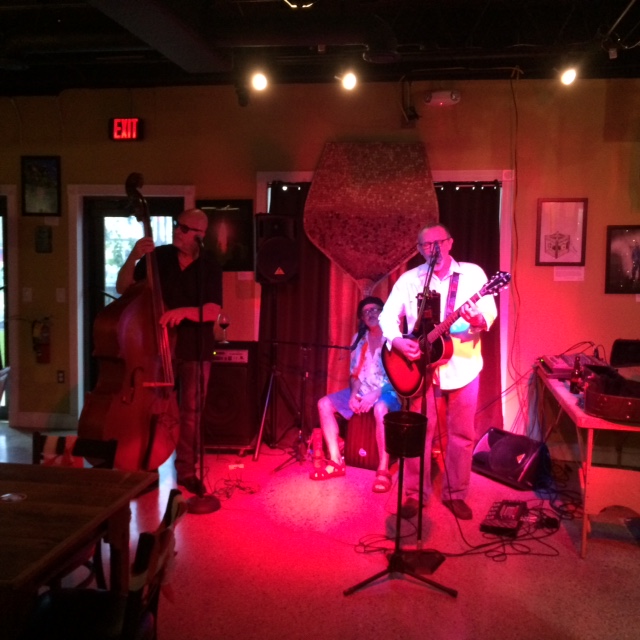
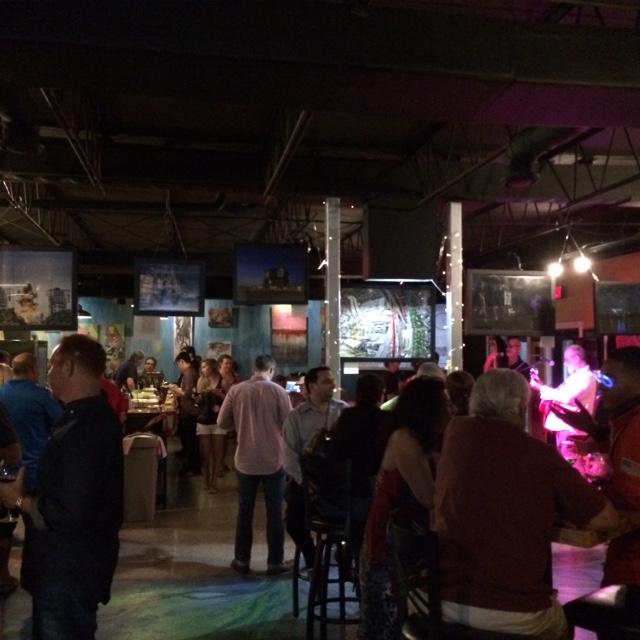
Laura Bart and Emily…to a takeover of a wine shop with a space art installation and band, as they had at Bacchae Wine Bar in Cape Canaveral, Florida last night…

image3 image4 image5 image6 image8…to a full-blown invasion of the Space & Rocket Center in Huntsville…Under the Saturn VThe point being, hey, it’s an excuse to party, have fun, be a tad silly, and hang out with people who share a common interest in, and love for, space exploration. Is there drinking? Certainly. Par for the course, I suppose. But the point isn’t just drinking, like other holiday gatherings I could name. And sometimes you can even do a little good. I recall that at least one of the Huntsville events raised money for Court Appointed Juvenile Advocates (CAJA). These are “my people,” so of course I join in, even if it gets a little loud at times.

***

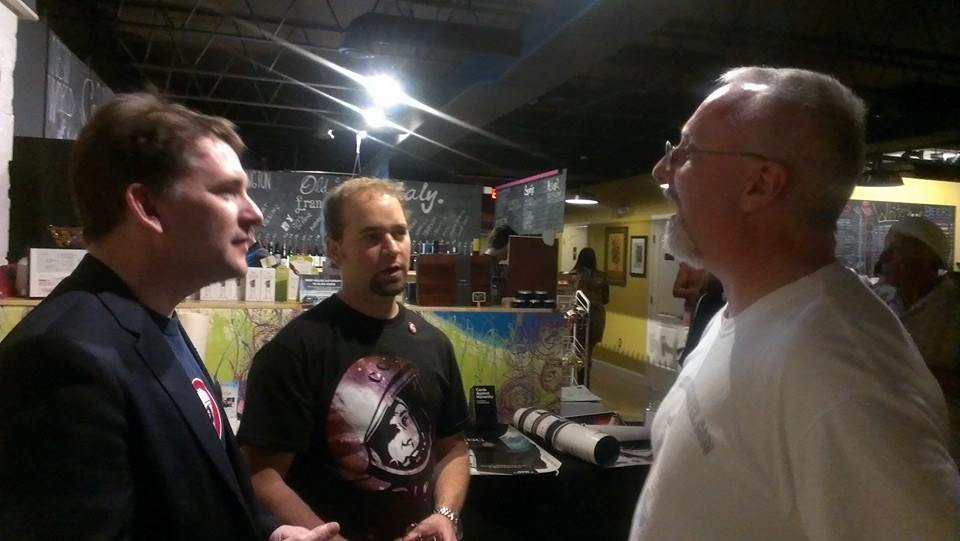
I always learn something or talk to interesting people at Yuri’s Night. This year, one of my interesting talks included Chris Lewicki, CEO of Planetary Resources, who was in Florida because his company’s Arkyd 3R satellite was about to be launched to the International Space Station. From ISS, it will be launched into a low-Earth orbit from the Kibo science module. Once in its proper orbit, it will test technologies that will eventually lead to an asteroid-detecting and -prospecting spacecraft.

Chris Lewicki Ryan Kobrick Me
From left to right, Chris Lewicki (Planetary Resources), Ryan Kobrick (Space Florida), and Your Humble Narrator, babbling on in my Science Cheerleader t-shirt

***

Another worthwhile chat I had was with Gabriel Rothblatt, a lawyer and space advocate who recently ran for Congress in Florida’s 8th District (the Space Coast, of course!). His big interest when we talked was in streamlining the process for commercial space companies that want to launch their rockets out of Cape Canaveral Air Force Station (CCAFS). He’s advocating for a “Port Authority” sort of structure, where the actual Port of Cape Canaveral would also have launch approval authority–from cruise ships to space ships!–and any potential launch customers would only have to go through one set of red tape to get approvals.

For instance, if SpaceX wants to launch off of Launch Complex 39A, they have to get approvals from NASA for use of the facilities but also from the U.S. Air Force, which maintains the Eastern Range off the Florida coast. A Port Authority for the Space Coast would maintain its existing facilities plus a few of the launch pads at CCAFS, which would be converted to commercial use. It would be the Port Authority’s job to centralize approvals so that a launch customer would only have to go through one round of red tape instead of two or more.

Rothblatt was also interested in some of the “singularity” technologies, including nanotechnology. Nanotech, theoretically, could extend life spans by providing people with molecule-sized robots in their bloodstreams that would kill things like cancer, clear out cholesterol, etc. Why get interested in longevity? Aside from extending life spans, it could change the dynamics of space investments. Rothblatt reasons that if people were living 150-200 years instead of 70-100, they might be more willing to invest in ventures such as space settlements, which will take decades beyond the usual planning (or investing…or even thinking) horizons of most people alive today.

A third cause Rothblatt advocates for is space settlement. “Fifty years ago, we had to send humans,” he said. “The computers weren’t that good or that fast. Now they’re getting to the point where they can most of the basic things without the need for humans. Space settlement is the only compelling reason to send humans into space” long-term. It’s hard to argue. Settlements mean families, communities, businesses, cultures, and all the things that (so far) only humans do. A lot of what he was saying sounded familiar, so I asked if he’d been talking with Rick Tumlinson. Indeed he had, which was why he was talking to Tumlinson’s New Worlds Institute about space settlement.

There are exciting things happening in the space business. It’s not quite that NASA-centric vision that America had in the 1960s, but a lot of our rapidly developing technologies are making space more democratized and, eventually, more accessible. And perhaps, more hopefully, dedicated individuals are willing to run for Congress to promote a technologically promising future. It’s that sort of thinking that makes even an introverted space geek like me happy he goes to a loud party once a year.

Well, Here I Am

Early in SpaceI’m not entirely certain where I’m going to go with this site…yet. So for awhile I might be drifting around space a bit like Jubal Early at the end of the last episode of Firefly. One thing that’s certain, I suppose, is that this page will replace my original Blogspot site, which was as plain-vanilla and anonymous as I could make it. This site? Not so much. This will be a place to consolidate all my various web adventures, professional and personal, with the goal of simultaneously sharing my thoughts while keeping the world at a distance. I’m an introvert, what’d you expect?

Anyhow, thank you for reading, if you’re there. More postings to come.